By Josiah Kariuki
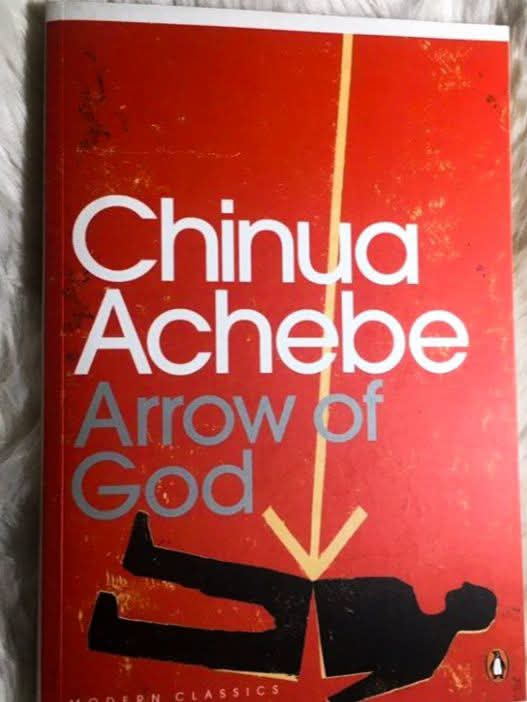
I am starting my Monday with Chinua Achebe’s Arrow of God, first published in 1964. More than six decades later, the novel remains a compelling study of leadership, power and the danger of becoming too convinced of one’s own righteousness.
Set in southeastern Nigeria during British colonial rule, the novel centres on Ezeulu, chief priest of Ulu, the deity revered by the people of Umuaro. His spiritual authority places him at the heart of community life, but his responsibilities become increasingly complicated as colonial administration disrupts traditional institutions and divisions emerge among his own people.
Also Read
Ezeulu finds himself caught between religious duty, personal judgment and the expectations of his community. His tragedy unfolds as these competing demands collide, exposing the limits of authority and the consequences of decisions made under pressure.
Achebe’s achievement lies in refusing to offer easy explanations. He does not portray traditional African society as a perfect world destroyed solely by European intervention. Neither does he present colonialism as progress. Instead, he shows a society with its own systems of authority, knowledge and belief, but also with internal rivalries that colonial power exploits.
The tragedy is therefore not simply a story of outsiders overpowering a community. It is also about what happens when internal divisions meet external interference, and when those entrusted with leadership struggle to recognise the consequences of their choices.
When conviction leaves no room for doubt
Ezeulu is particularly fascinating because he does not consider himself a man pursuing personal power. He believes he is serving a sacred responsibility. Yet his understanding of that responsibility becomes a source of conflict, raising an uncomfortable question: what happens when a leader becomes so convinced of his mission that he can no longer examine his own judgment?
There is a difference between defending a principle and insisting that one’s interpretation of that principle must prevail at all costs. A leader may sincerely believe he is protecting an institution, a tradition or a community, yet fail to see how his approach is weakening the very thing he hopes to preserve.
This is where Arrow of God moves beyond its historical setting.
In government, business and public institutions, the danger is not always a leader without principles. Sometimes it is a leader who cannot separate those principles from personal pride. Disagreement becomes disloyalty, criticism is treated as hostility, and compromise is mistaken for weakness.
Such leaders may believe they are demonstrating strength when, in reality, they are shutting themselves off from information and advice that could help them avoid costly mistakes.
Achebe does not make Ezeulu a one-dimensional villain. His predicament is shaped by religious obligations, political rivalries, colonial interference and his own understanding of events. That complexity makes his story more instructive. His tragedy lies partly in the gap between what he believes he is defending and the consequences of the choices he makes.
Good intentions, after all, do not automatically produce good outcomes.
Leadership is also about the people
Achebe’s scrutiny does not end with Ezeulu. Umuaro is a divided community whose members have their own interests, loyalties and interpretations of the unfolding crisis. They are not simply spectators waiting to see whether their chief priest succeeds or fails. Their responses influence events and expose the fragile relationship between authority and those expected to recognise it.
This raises another question: can leadership remain effective when the people and the institutions involved no longer share a meaningful understanding of their obligations to one another?
Authority may come from tradition, law or appointment, but its exercise requires judgment, accountability and trust. A leader may retain a formal position while losing the confidence of those whose cooperation is necessary for that position to have meaning.
The lesson applies to institutions of every kind. Leadership is not merely about issuing instructions or standing one’s ground. It also requires listening, understanding competing interests and recognising when a course of action is producing results contrary to its original purpose.
The novel also challenges us to think carefully about tradition and change. Tradition provides identity and continuity, but preserving it does not mean rejecting every adjustment. Equally, change is not necessarily progress simply because it introduces new systems or ideas.
Societies undergoing political, technological and institutional transformation face this tension every day. Reforms must consider the people affected, the institutions they may disrupt and the trust required to make them work. Change imposed without understanding or public participation can create resistance rather than progress.
As I begin this Monday, *Arrow of God* reminds me that there are moments when principle demands resistance and others when wisdom demands reconsideration. The challenge is knowing the difference without allowing pride or the desire to be proved right to make the decision.
Achebe’s enduring lesson is that leadership requires more than conviction. It requires the humility to question one’s judgment, the courage to acknowledge mistakes and the wisdom to recognise that protecting an institution is not the same as protecting one’s position.
Some battles are worth fighting to the end. Others require us to pause and reconsider what we are fighting for.
That is why Arrow of God remains worth reading. Its story belongs to colonial Nigeria, but its questions about power, responsibility and human judgment belong to all of us.