By Otuma Ongalo
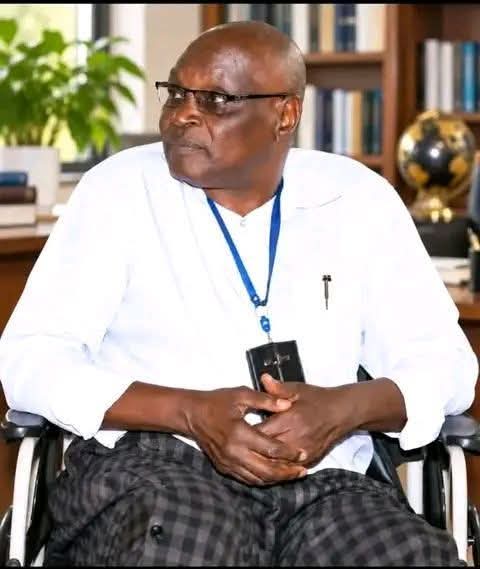
The passing of Prof. Christopher Wekesa Mukwa—Chris Mukwa to those who knew him closely—is a personal blow to me, as it must be to the thousands of education students who passed through his hands during his long and distinguished career.
I was among the pioneer group of 8-4-4 students who encountered Mukwa at Moi University between 1990 and 1995. We were young men and women preparing to enter the teaching profession, unaware that some of the lecturers we casually called “Sir” would remain in our memories decades after we left the university. Chris Mukwa was one of them.
Also Read
What struck me first about Mukwa was his humility and humour in the discharge of his duties. He dressed modestly but decently and did not carry the intimidating academic air associated with many professors of his generation. There was no ostentatious display of scholarship about him. He was a professor—those days, a doctor—who seemed entirely comfortable being simply Chris.
He related to students in a fatherly manner. He was generous in recognising what a student had got right, without lowering academic standards. In his marking, he seemed to believe in giving the devil his due and, on some occasions, giving the student a little more than the devil expected.
There was another side to his humility that amused us. In those days, Mukwa owned a matatu. However, whenever he travelled from Lugulu towards Eldoret in his vehicle, he could be found seated at the back among ordinary passengers. Here was a university don who had studied at some of the finest institutions abroad, but who saw no reason why his academic qualifications should require him to occupy the privileged seat in his own matatu.
That was Chris.
His years of study in the United States had not erased the man from Lugulu. He spoke authentic English, but it carried a rich Bukusu flavour that he wore without apology. It became part of his charm. He had a natural swagger, which he displayed as he strode across the giant Lecture Hall 1, putting his points across with the confidence of a man completely at home with his subject.
Mukwa was particularly in his element when teaching Educational Media, where humour met intellect. He constantly emphasised the importance of teaching aids and practical illustration in the classroom.
“Class, you should use various teaching aids in the classroom to enhance understanding. You don’t have to bring a whole crocodile in class and declare, ‘Here is the crocodile!’”
He would roar this in his unmistakable Bukusu-flavoured English, and the lecture hall would erupt. Beneath the laughter, however, was a serious pedagogical message. Teaching was not simply about standing before learners and talking. A good teacher had to find ways of making learning visible, concrete and memorable.
A man who devoted his scholarship to educational media had himself become an unforgettable teaching aid. Decades later, many of us can still hear his voice.
His interaction with fellow staff members was equally collegial. He did not carry himself as someone who needed to remind colleagues or students that he was a prominent don. His scholarship was evident, but it never became a barrier between him and other people.
I experienced this during my second teaching practice. In 1994, I was posted to Chesamisi High School, where Mukwa was my supervisor. He arrived quietly and modestly, using public transport and a boda boda, true to his nature. He was not in a hurry. He settled down, took generous cups of tea as he waited for the opportune moment, and eventually went to observe my lesson.
There was no intimidating supervisor’s demeanour. In the classroom, there was no pressure and no tension. He sat comfortably at the back, looking almost as though he, too, was enjoying the lesson. For a young teacher being assessed, it was an extraordinary experience. The supervisor was there, but somehow he made you forget that you were being supervised.
The feedback was candid, fair and constructive. There was no unnecessary grandstanding. He told you what you had done well and what needed improvement. Again, the professor disappeared and the teacher emerged.
Accomplished academic
There was something else special about the occasion. Chesamisi was his former school. I later learnt that the man who became an accomplished academic had passed through those same classrooms. He had not merely been a brilliant student; he had excelled beyond the classroom as well.
His exploits in the 400 metres, which he reportedly dominated in his day, were still the subject of conversation around Chesamisi and its environs, including neighbouring Kamukuywa.
The professor we knew at Moi University had once been the athletic star whose speed was remembered in the villages around his home.
That is the Chris Mukwa I remember: scholar, teacher, athlete, humourist, mentor and an ordinary man who never seemed interested in behaving like an extraordinary one.
I never met Mukwa again after my teaching practice, yet I never quite lost touch with him. Every time I pass his eucalyptus-clustered compound along the Webuye-Kitale Highway near Lugulu Market, I still steal a glance in his direction, even though I may not consciously expect to see him.
Mukwa has also remained a subject of favourable discussion in our Moi 95 WhatsApp group. We occasionally summon memories of our days at Moi University, and his name inevitably evokes smiles, stories and admiration.
That is one of the greatest tributes a teacher can receive.
Prof. Christopher Wekesa Mukwa leaves behind a remarkable academic legacy.
He earned a Bachelor of Arts with Education from the University of Nairobi in 1975. He subsequently pursued doctoral studies at Michigan State University, where he earned his PhD in Education in 1979. His doctoral dissertation, Toward a Systematic Approach to Educational Media Use in the Secondary School Education of the Republic of Kenya, examined the tools and technologies available for learning in Kenyan secondary schools.
It is difficult not to marvel at the foresight of that scholarship. Long before educational technology became fashionable language in education, Chris Mukwa was studying how media and technology could improve teaching and learning in Kenyan schools.
He went on to build a long career in education and became part of the distinguished generation of scholars who shaped the School of Education at Moi University. His later scholarly work continued to touch on curriculum, instruction, educational media and the professional competence of teachers. Even in 2016, he was still publishing research on teaching and learning in Kenya.
Academic records, however, tell only part of the story. They can tell us when he graduated, where he studied, what he researched, what he published, the titles he acquired and the institutions in which he served.
They cannot tell us about the professor who sat at the back of a classroom in Chesamisi and made a nervous student teacher feel at ease. They cannot tell us about the professor who rode at the back of his own matatu with ordinary passengers. They cannot reproduce the roar of “You don’t have to bring a whole crocodile in class!” They cannot adequately capture the man whose English carried both the authority of a scholar and the unmistakable warmth of his Bukusu roots.
That is the Chris Mukwa I choose to remember.
As I reflect upon him today, I am reminded of the haunting question that Shakespeare so often makes us confront when a remarkable life comes to an end: whence cometh another?
Indeed, whence cometh another Chris Mukwa?
Farewell, Professor. Farewell, teacher. Farewell, supervisor. Farewell, my lecturer. Farewell, Chris—my namesake.
May you rest in peace.
-The author is a veteran journalist.