By Nyang’au Araka
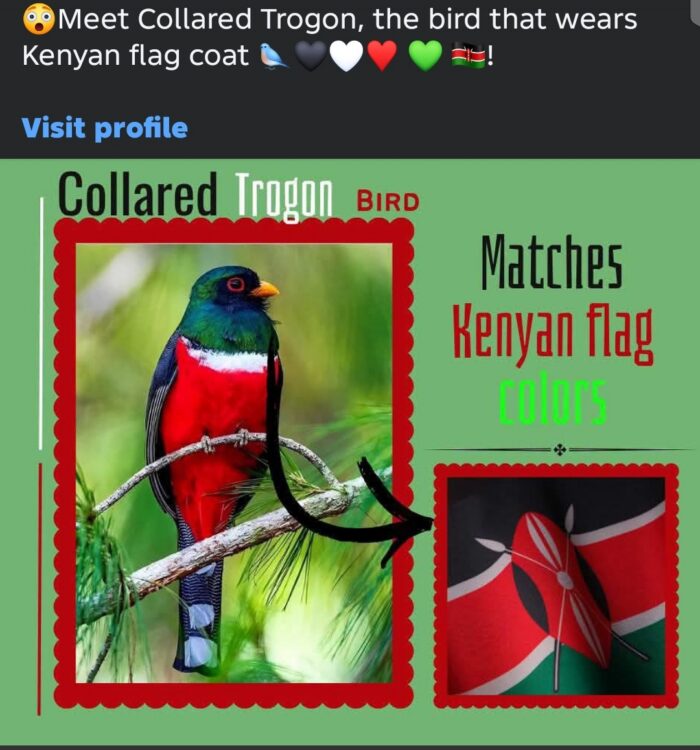
Photographs of a strikingly colourful bird are currently circulating on social media, with many Kenyans doing a double take over what appears to be a remarkable resemblance to the colours of the national flag.
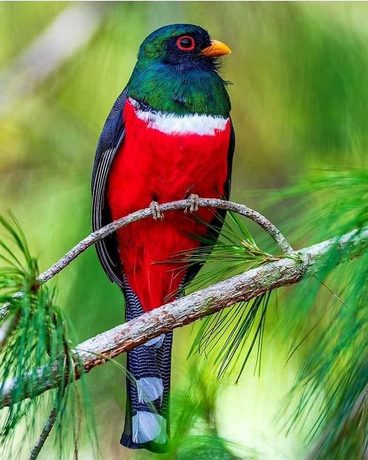
The bird in the photographs is the Collared Trogon, Trogon collaris, a spectacular forest species whose green upperparts, vivid red belly and contrasting black-and-white markings create an almost uncanny combination of colours familiar to every Kenyan.
Also Read
It is, of course, only a coincidence, because the Collared Trogon is not native to Kenya and has no connection to the country’s national colours.
Online sources show that the species is found in forested parts of the Americas, with its range extending from Mexico through Central America and into parts of South America.
Yet the photographs make the comparison difficult to resist, particularly when the bird is perched in good light and its brilliant green plumage catches the eye against the rich red of its underparts.
The male is particularly striking, with the combination of metallic green upperparts and bright red underparts making it one of the more visually distinctive members of the trogon family.
Its black-and-white markings provide an additional contrast, giving the bird an appearance that seems almost too carefully arranged to have been produced by nature.
The Collared Trogon has an interesting relationship with the forest environment.
Sources indicate that it feeds on insects and other small invertebrates, while also eating fruit, meaning that its feeding habits connect it both to the control of insect populations and to the movement of seeds through the forest ecosystem.
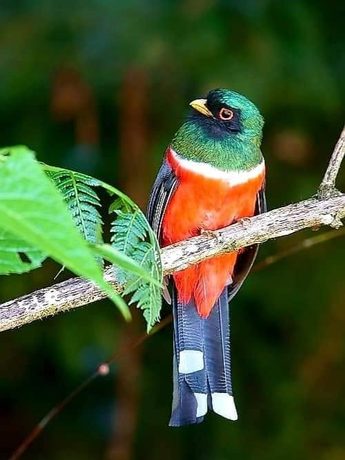
Unlike some brightly coloured birds that are constantly active and noisy, the Collared Trogon can spend considerable time sitting quietly on a branch, watching its surroundings before making a sudden movement to catch prey or move towards food.
Its name comes from the distinctive collar-like markings around its body, which become particularly noticeable when the bird turns on its perch and the light catches its plumage from different angles.
That combination of stillness and sudden movement is part of what makes photographs of the species so captivating, especially when the image captures the green, red, black and white colours together.
For Kenyans encountering the photographs online, however, the scientific details may take second place to the obvious visual joke: here is a bird that appears to have turned up wearing the national colours.
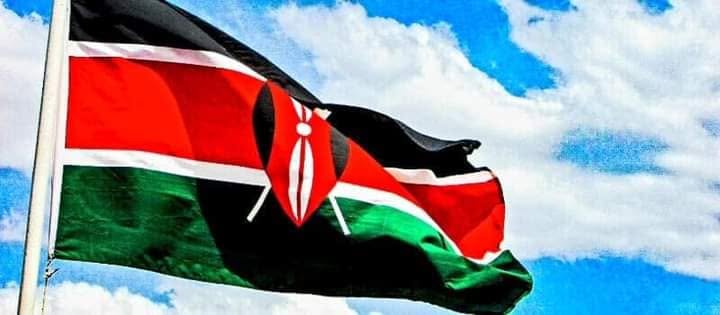
Nature, naturally, did not design the Collared Trogon for Kenya, and there is no political message hidden in its feathers, but the coincidence is striking enough to make the photographs memorable.
Kenya’s flag is more than a striking combination of black, red, green and white, with each colour carrying a meaning tied to the country’s history, people and natural heritage.
Black represents the people of Kenya, red symbolises the blood shed in the struggle for independence, while green reflects the country’s fertile land and natural wealth, with white representing peace and unity.
So, while the Collared Trogon may have borrowed the colours by pure chance, its spectacular plumage offers a beautiful reminder of the symbolism carried by one of Kenya’s most recognisable national emblems.
For a country accustomed to seeing its flag on everything from sporting jerseys to national celebrations, perhaps it is only natural that Kenyans would pause when a beautiful bird appears to have arrived dressed in exactly the same colours.