By Nyang’au Araka
The massacre that turned Kisumu into a killing field, when security forces opened fire on civilians 57 years ago, is being commemorated today (Sunday, October 25, 2026).
Residents and human rights groups are commemorating the victims of one of Kenya’s darkest moments in post-independence history.
Also Read
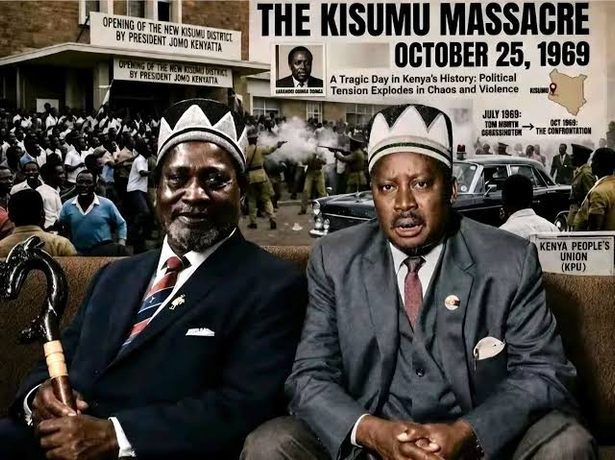
The commemoration, taking place in Kisumu on revisits the events of October 25, 1969, when a presidential visit to open the Soviet Union-built Nyanza Provincial General Hospital, the popularly known as Russia Hospital.
The incident, remembered as the Kisumu Massacre, left dozens of people dead or injured, although the exact number of fatalities remains disputed.
Official records put the death toll at 11, but eyewitness accounts and historical submissions to the Truth, Justice and Reconciliation Commission (TJRC) suggest that many more people were killed, with some estimates placing the number at 100 or more.
The tragedy unfolded against a tense political background, just months after the assassination of prominent politician Tom Mboya in Nairobi on July 5, 1969. His killing had triggered anger and suspicion, particularly in Nyanza, where many residents questioned the circumstances surrounding his death.
Kenyatta arrived in Kisumu at a time of deep political hostility between his administration and his former Vice-President, Jaramogi Oginga Odinga, who had broken away from the ruling KANU party to lead the opposition Kenya People’s Union (KPU).
At the event, sections of the crowd reportedly chanted “Dume!”, the KPU symbol, while demanding to know what had happened to Mboya.
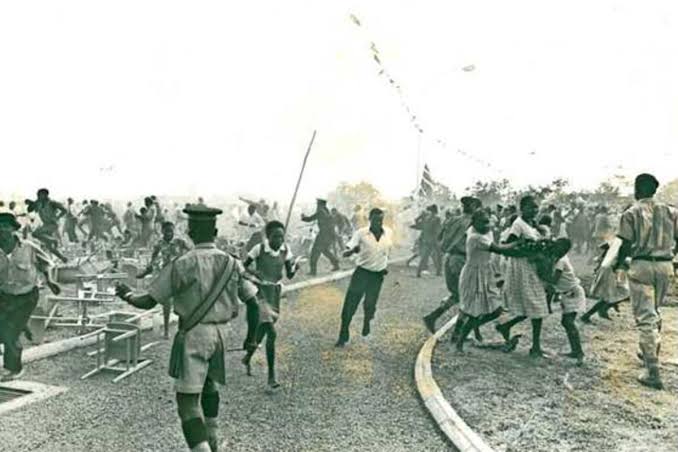
The confrontation escalated when Kenyatta and Odinga exchanged sharp words during the public function. Stones were reportedly thrown, prompting the presidential security detail and General Service Unit (GSU) officers to open fire.
Historical accounts indicate that the shooting continued as the presidential convoy left Kisumu, with security officers firing along the route for several kilometres beyond the town. The TJRC report records that the shooting extended about 25 kilometres outside Kisumu.
“When the dust settled, the ‘Kisumu Massacre’ of 1969 was complete, with many shot dead, including school pupils, by the presidential security,” the TJRC Report, Volume IIA, Chapter One, paragraph 69 says.
Among those caught in the violence were schoolchildren who had attended the event. Accounts by survivors and witnesses describe scenes of panic as people fled gunfire, with some injured or trampled in the ensuing stampede.
The consequences extended far beyond the immediate loss of lives. In the aftermath, the government banned KPU, detained Odinga and other party officials without trial, and imposed a curfew in parts of Nyanza. Hundreds of people were also arrested during the crackdown.
The massacre deepened the political divide between the government and the region, leaving a legacy of mistrust that continues to feature in discussions about state violence, political exclusion and historical injustices.
The hospital whose opening occasioned the presidential visit has since been renamed Jaramogi Oginga Odinga Teaching and Referral Hospital (JOOTRH), preserving the memory of a political figure whose confrontation with Kenyatta became inseparable from the tragedy.
Today, the questions surrounding the true number of victims, accountability and the long-term consequences of the killings remain part of the country’s unresolved historical conversation.