By Nyang’au Araka
About 379,000 people across 13 counties have been affected by rising water levels in lakes across Kenya.
Now, Parliament is warning that more interventions are needed to protect communities, property and critical infrastructure from the growing environmental crisis.
Also Read
The scale of the crisis emerged on Friday when the National Assembly Departmental Committee on Environment, Forestry and Mining met the Ministry of Environment, Climate Change and Forestry to examine the findings of a multi-agency assessment into the phenomenon.
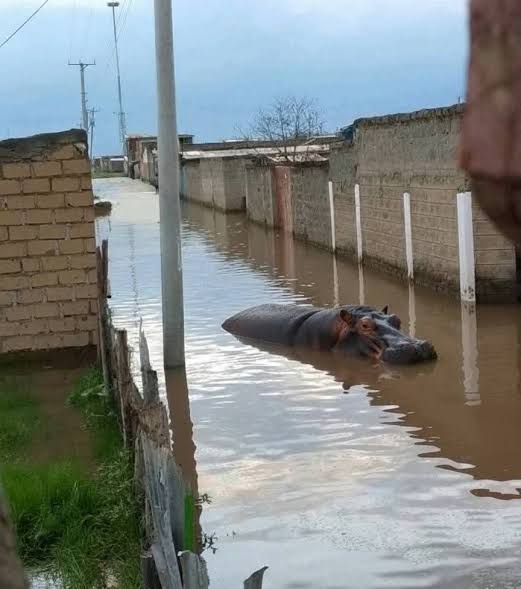
The inquiry comes amid growing concern over the expansion of several lakes, particularly in the Rift Valley, where rising waters have submerged homes, schools, health facilities, roads, farmland and tourism establishments, forcing families to abandon their homes and livelihoods.
Presenting the assessment to MPs, the Ministry’s technical team said the phenomenon, which has become increasingly pronounced since 2013, was being driven by several interacting factors, including increased rainfall in lake catchment areas, degradation of catchments and underlying geological processes.
The assessment documented far-reaching effects on human settlements, infrastructure, education, agriculture, fisheries, energy production and tourism, as well as changes in lake ecosystems that have intensified human-wildlife conflicts.
Committee Vice-Chairperson Charles Kamuren (Baringo South), who chaired the meeting, welcomed government interventions already undertaken, including the diversion of River Loboi and River Wasikas, which previously drained into Lake Bogoria.
However, he said more needed to be done to address the suffering of communities living around the affected water bodies.
“The suffering that my people are undergoing really is a big challenge as a result of this climate change,” Kamuren told the meeting.
“I still call that we put more efforts to safeguard the lives and the properties of the people,” he added, urging the government to sustain and strengthen its response.
The crisis extends beyond Baringo County, with several lakes in the Rift Valley and other parts of the country experiencing significant changes in their water levels.
The affected water bodies identified in previous government assessments include Lakes Baringo, Bogoria, Nakuru, Elementaita, Solai, Naivasha, Ol Bolossat, Magadi, Turkana and Victoria, as well as Lake Logipi and the Turkwel Gorge Dam.

The impacts have varied from one location to another, but the common challenge has been the loss of homes, productive land, public facilities and access to essential services.
In Baringo, rising waters in Lakes Baringo and Bogoria have submerged settlements, grazing areas, roads and tourism facilities.
The Marigat-Chemolingot road has also suffered disruptions, while the expansion of Lake Bogoria has submerged parts of its hot springs and geysers.
In Nakuru County, Lake Nakuru has inundated parts of Mwariki estate and sections of infrastructure within the national park.
Around Lake Naivasha, homes, flower farms, roads and businesses have also been affected, with some neighbourhoods experiencing extensive flooding.
Further north, rising waters in Lake Turkana have affected communities along the shoreline, including the El Molo, whose livelihoods and access to essential services have been disrupted.
Earlier government assessments documented the displacement of 75,987 households, representing approximately 379,935 people, across 13 counties, underscoring the humanitarian scale of the problem.
The latest parliamentary deliberations come as authorities face pressure to move beyond emergency interventions towards sustainable solutions that address both the causes and consequences of the expanding waters.
Scientists have also been examining the causes of the unusual expansion, with evidence pointing to changing rainfall patterns, catchment conditions and geological processes.
A study published in the journal Nature Africa in April 2026 highlighted the growing threat posed by rising waters in the East African Rift Valley.
Researchers noted that increased rainfall was a major contributor to the expansion of lakes, with some communities facing the possibility of significant changes to their surrounding landscapes.
“Our analyses show that increased rainfall is the primary driver, particularly changes in quantity and intensity,” hydrologist Mathew Herrnegger said in the report.
A separate study published in Frontiers in Environmental Science found that Lakes Baringo and Naivasha recorded particularly large increases in flooded surface area during the period examined, with increases of 52.63 per cent and 42.62 per cent respectively.
The research also highlighted the role of lake topography in determining the extent of flooding.
In April 2026, NASA also reported that satellite measurements showed Lake Naivasha’s water level had risen by as much as seven metres between 2010 and 2026.
The expansion has effectively brought Lake Oloidien into the Naivasha water system, raising concerns about changes to the freshwater lake’s ecological balance.
The parliamentary inquiry is expected to inform further government interventions, including measures to protect vulnerable communities, restore degraded catchments and improve the resilience of infrastructure in affected areas.

Climate legislation also under scrutiny
Apart from the rising lake waters, the committee used the meeting to examine the Environmental Laws (Amendment) Bill, 2024, with the Ministry presenting proposed changes to the Forest Conservation and Management Act and the Climate Change Act.
The discussions particularly focused on a proposed amendment to Section 8 of the Climate Change Act and its implications for Kenya’s international climate reporting obligations under the Paris Agreement.
The Ministry explained that the country’s reporting framework covers six key sectors: energy, agriculture, forestry, transport, waste and industrial processes.
It cautioned against introducing a provision that singles out one sector, arguing that this would undermine the comprehensive reporting obligations established under the international climate framework.
“A country cannot report on one sector, but it has to report on the six sectors that have been provided for by the IPCC committee,” Ministry representative Linah Meeme told MPs.
Meeme further explained that proposed changes relating to forest conservation had already been addressed through amendments to the Forest Conservation and Management Act submitted by the President.
She said strengthening forest conservation, reducing deforestation and restoring degraded ecosystems would help lower greenhouse gas emissions and support Kenya’s transition towards low-carbon development.
The two issues underscore the growing challenge facing policymakers: protecting communities from the immediate consequences of changing environmental conditions while strengthening the legal and institutional frameworks needed to address climate change over the long term.
-Additional information obtained from a story filed by the Parliamentary press team