By Nyang’au Araka
Equity Group Holdings has posted a 32 per cent increase in profit after tax to KSh71.5 billion for the nine months ending September 2026.
The lender’s profit rose from KSh54.1 billion in the corresponding period last year, while profit before tax increased 37 per cent to KSh89.8 billion from KSh65.6 billion.
Also Read
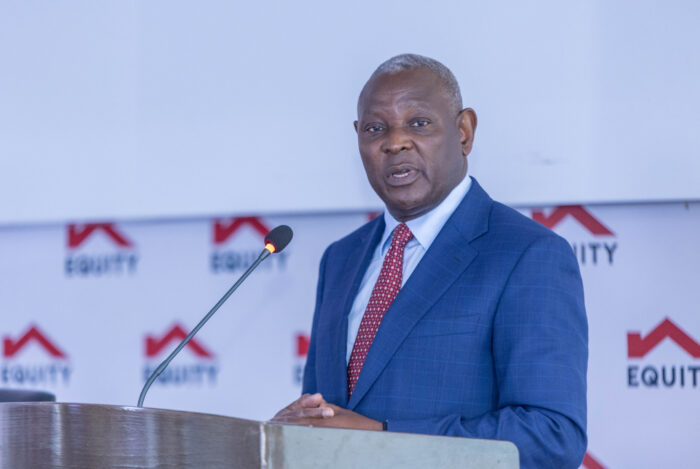
Group Managing Director and Chief Executive Officer James Mwangi attributed the growth to regional expansion, revenue diversification, improved asset quality and investments in technology.
“Equity’s Q3 2026 performance reflects the successful execution of a multi-year transformation agenda that has strengthened the Group’s resilience, diversified its earnings base and enhanced operational scalability through technology,” he said.
The results released on Tuesday show that total income increased 23 per cent to KSh192 billion from KSh156.2 billion, supported by growth in interest and non-funded income.
Net interest income rose 15 per cent to KSh107.7 billion, while non-funded income grew 34 per cent to KSh84.3 billion from KSh62.7 billion. Non-funded income now accounts for 44 per cent of total income, up from 40.1 per cent in the same period last year.
The group’s total assets expanded 18 per cent to KSh2.15 trillion, while customer deposits increased 19 per cent to KSh1.58 trillion. Net loans grew 17 per cent to KSh1.01 trillion, reflecting increased demand across corporate, retail, micro, small and medium enterprises (MSMEs) and public sector segments.
The group serves more than 24 million customers through 411 branches, 883 ATMs, 95,510 agency outlets and 1.4 million merchants, alongside digital platforms including Equity Mobile, Equitel, *247# and Equity Online.
Digital adoption continued to deepen, with 98.3 per cent of transactions conducted outside branches and 89.5 per cent processed through digital channels.
Mwangi said the group’s transformation was positioning it beyond traditional banking towards an integrated financial services model.
“Through disciplined execution and continued investment in technology, talent and distribution, we are creating a scalable platform capable of serving customers across multiple markets and financial needs under our One Equity ecosystem,” he said.
He added that Kenya’s economic growth was expected to remain between 4.5 and five per cent, with other regional markets offering opportunities supported by infrastructure investment, structural reforms and favourable demographics.
The group’s operational efficiency improved, with its cost-to-income ratio declining to 47.9 per cent from 50.6 per cent.
The non-performing loans ratio also dropped to 9.3 per cent from 12.1 per cent, while the cost of risk improved to 1.5 per cent from 1.9 per cent. Non-performing loans coverage stood at 71 per cent.
Equity Bank Kenya recorded a 31 per cent increase in profit after tax to KSh40.7 billion from KSh31.1 billion.
Its assets grew seven per cent, supported by 10 per cent deposit growth and 12 per cent loan growth.
The bank also disbursed 34 per cent of the KSh245 billion in MSME loans issued in Kenya between January and June 2026.
Regional subsidiaries accounted for 42 per cent of the group’s banking profitability. Equity BCDC in the Democratic Republic of Congo (DRC) increased profit after tax by 34 per cent to KSh18.5 billion, while Tanzania recorded 60 per cent growth to KSh2.4 billion. Rwanda posted a 10 per cent increase to KSh4.4 billion.

The insurance business also recorded strong growth, with gross written premiums rising 52 per cent to KSh10 billion and profit before tax increasing 34 per cent to KSh1.96 billion.
Eighty per cent of its policies were distributed digitally, while 7.3 million unique customers accessed life insurance products.
Further, the Equity Group Foundation reported supporting 11,663 active high school scholars, bringing the cumulative beneficiaries of its Wings to Fly and Elimu scholarship programmes to 60,009.
It also facilitated more than KSh457.1 billion in credit access for MSMEs and trained over one million entrepreneurs.
Its agricultural programmes include the USD25 million SASTAIN initiative targeting 60,000 smallholder farmers and agricultural enterprises in Tanzania and the DRC.
The foundation has also planted more than 50.2 million trees, while the group secured accreditation as a Direct Access Entity to the Green Climate Fund, enabling it to mobilise climate financing directly.
In healthcare, Equity Afya expanded its network to 159 medical centres, which have recorded more than 5.7 million patient visits.
It also opened its first two community pharmacies as part of a longer-term plan to establish 1,000 outlets across the region.
The group said it had met or exceeded management guidance across its key performance indicators and remained focused on its Africa Recovery and Resilience Plan 2030, which targets operations in 15 countries and service to 100 million customers through technology-driven financial services.