By Nyang’au Araka
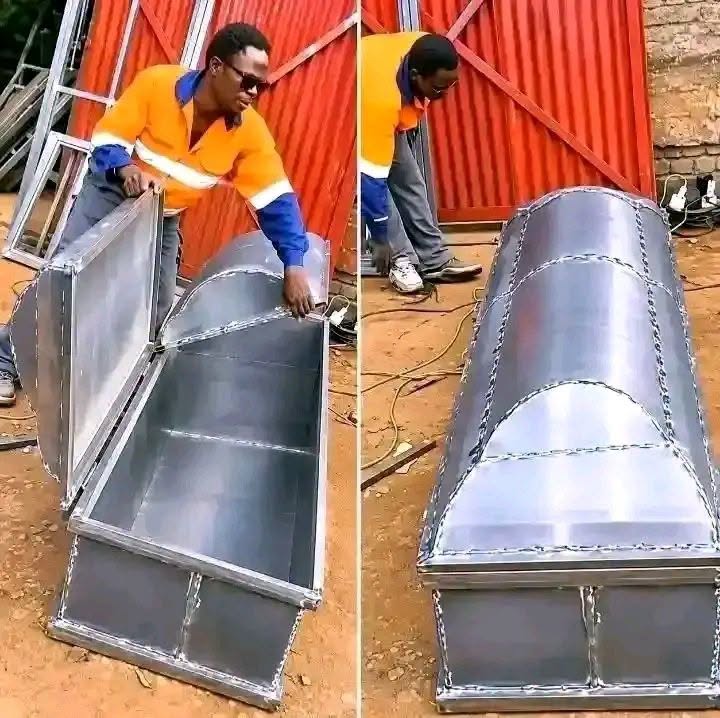
Just when Kenyans thought they had seen almost everything in the business of coffins, a Kisumu welder has come up with an unusual twist: a coffin made of metal.
The innovation by a welder identified as Otieno has sparked curiosity and debate, adding an unexpected dimension to an industry traditionally associated with carpenters, timber, upholstery and polished wooden boxes.
Also Read
While most people associate metalwork with gates, windows, doors and machinery, Otieno has turned his welding skills towards something rather different – making a resting place for the departed.
His motivation, however, is less about changing burial traditions than exploring the commercial possibilities of his trade, according to information shared online by Keiyo News.
Otieno says the idea is driven “by the desire to explore new business opportunities and demonstrate that metal can be transformed into unique and valuable products.”
He has also been quick to dispel speculation that his metallic creation is intended to delay decomposition. Rather, he says, it is simply an alternative product for a market that has traditionally relied on wooden coffins.
In Kisumu, coffin-making has previously produced some unusual craftsmanship. In 2011, artisans from the Kisumu Innovation Centre made a woven coffin for Nobel laureate Prof Wangari Maathai using water hyacinth, papyrus reeds and bamboo, in keeping with her environmental conservation legacy.
The trade has also created opportunities for people who might otherwise have struggled to find employment.
A 2025 Citizen Digital report profiled Maureen Anyango and Penina Atieno, two women then working in a coffin-making workshop near Jaramogi Oginga Odinga Teaching and Referral Hospital (JOOTRH).
Their experience challenged the perception that coffin-making is exclusively men’s work, with Maureen insisting that it was simply an honest way of earning a living.
Now, Otieno appears to be taking the industry’s experimentation in another direction, this time with a welding machine rather than a carpenter’s tools.
Whether the metallic coffin will win over customers remains to be seen. After all, families have their own preferences when choosing how to lay their loved ones to rest, and tradition is not always easily displaced.