By Nyang’au Araka
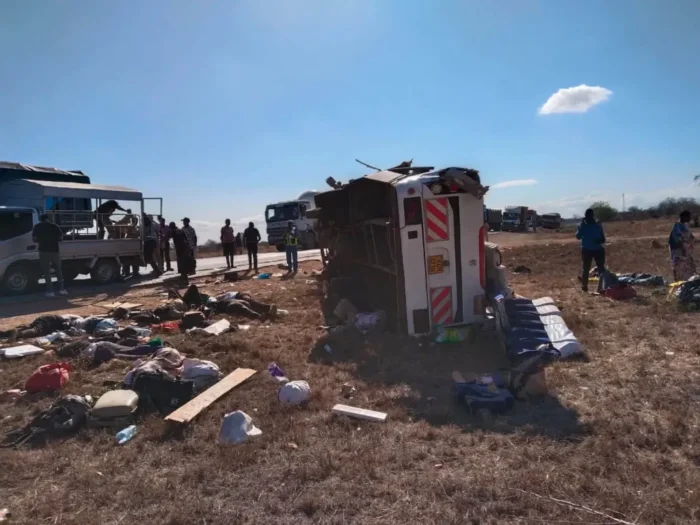
The deaths of 24 people in a road crash at Kanga along the Nairobi-Mombasa Highway recently have renewed calls for urgent action to address Kenya’s escalating road safety crisis.
The National Transport and Safety Authority (NTSA) is now proposing that road accidents be declared a national disaster.
Also Read
“Road crashes have reached a national emergency level, with about 20,000 crashes claiming over 5,000 lives annually,” NTSA said in a statement.
“As an Authority, we propose that road traffic crashes be declared a national disaster to mobilise urgent government action, secure adequate funding and ensure coordinated enforcement.”
The Kanga tragedy, involving a church bus and a commercial tipper truck on Sunday, came barely three weeks after another 17 people, mostly Catholic pilgrims, died in a multiple-vehicle collision along the same highway.
Together, the two tragedies have claimed at least 41 lives in less than a month on one of the country’s busiest transport corridors.
This has raised difficult questions about the effectiveness of existing road safety measures.
The tragedies have claimed the lives of parents, children, spouses, friends and relatives, leaving behind families struggling to come to terms with sudden loss.
The Kanga accident occurred at about 7.45am when a bus belonging to Power of the Word Church International, carrying passengers returning from a funeral in Western Kenya, collided with an oncoming truck.
Initial reports indicated that the bus driver was attempting to overtake a line of vehicles when the collision occurred. Investigations were launched to establish the precise circumstances surrounding the crash.
The impact tore through the bus, leaving it extensively damaged and several passengers dead or injured. The injured were taken to nearby health facilities, including Mtito Andei Sub-County Hospital.
The scale of the tragedy was further reflected in the identification of victims at the hospital mortuary, where relatives gathered to establish whether their loved ones were among those killed.
The accident prompted President William Ruto to direct a thorough inspection of public service vehicles to ensure compliance with safety standards.
He also urged motorists, particularly those operating passenger vehicles, to exercise caution and prioritise the lives of those they transport.
“This is a painful and devastating loss for the families and for the nation. We share in your grief during this difficult time, and we pray for strength and comfort for the families. I also wish a quick recovery to all those who were injured,” Ruto said.
The Ministry of Roads and Transport indicated that preliminary reports pointed to improper overtaking, although investigations were still underway to establish the full circumstances of the collision.
A worrying pattern of highway tragedies
The Kanga accident was not an isolated incident.
On October 3, 17 Catholic pilgrims, most of them women, died at Mlima Kiu near Salama in Makueni County when a lorry attempting to overtake another truck triggered a multiple-vehicle collision involving their hired minibus.
The pilgrims were travelling from Mombasa to the Subukia National Shrine in Nakuru County for a prayer event.
The two accidents, occurring within three weeks on the same highway, have exposed the dangers associated with risky overtaking and the vulnerability of passengers travelling in groups.
A report by the Daily Nation further highlighted the scale of the problem, noting that three major accidents on the Nairobi-Mombasa Highway within a period of three months had claimed 41 lives. Several sections of the highway have previously been identified as accident black spots.
Across the country, pedestrians, motorcyclists, passengers and other road users continue to bear the consequences of preventable crashes.
According to the Kenya National Bureau of Statistics (KNBS) Economic Survey 2026, road fatalities increased from 4,748 in 2024 to 5,009 in 2025, representing a 5.5 per cent increase.
Reported road traffic accidents also rose from 11,165 in 2024 to 11,638 in 2025, while the combined number of people killed and injured reached 24,905.
NTSA estimates that approximately 20,000 crashes occur annually, resulting in more than 5,000 deaths.
NTSA wants disaster declaration
Against this background, NTSA has proposed that road traffic crashes be declared a national disaster to mobilise a coordinated government response.
In a statement, the authority said the scale of road deaths had reached an emergency level, with the annual toll destroying families, overwhelming the health system and undermining economic productivity.
“Road safety is not just a transport issue; it is a national development and security priority,” NTSA said as it proposed that road accidents be declared a national disaster.
The proposed declaration would bring together road agencies, the National Police Service (NPS), the health sector and county governments under clear accountability structures, with measurable targets for reducing fatalities and serious injuries.
“Our goal is simple: save lives, reduce fatalities and serious injuries, and protect Kenya’s human capital,” the Agency said.
“With everyone’s support, we can avert this disaster.”
What needs to change?
The renewed calls for action have brought into focus several interventions that could help reverse the worrying trend.
First, enforcement against dangerous overtaking and speeding needs to become more consistent, particularly along highways with a history of fatal collisions. Motorists should be discouraged from taking unnecessary risks to save a few minutes on the road.
Secondly, vehicle inspections must go beyond routine paperwork. The President’s directive for thorough inspections of public service vehicles presents an opportunity to establish whether vehicles are mechanically sound, properly licensed and compliant with passenger safety requirements.
Driver fatigue is another critical concern, particularly among drivers undertaking long-distance journeys. Transport operators need to enforce adequate rest periods, avoid excessively long shifts and ensure that drivers are physically fit before embarking on journeys.
The Ministry of Roads and Transport has also identified speeding, dangerous overtaking, drunk driving, overloading and driver fatigue among common contributors to road crashes. It has previously called for a combination of public education and targeted enforcement to address these risks.
There are also calls for road infrastructure improvements, including better signage, lane markings, lighting and appropriate safety barriers, particularly at identified accident black spots. Authorities should regularly review such locations and implement recommendations arising from road safety assessments.
Equally important is the need to strengthen emergency response systems, including ambulance services, hospital preparedness and coordination among agencies responding to major accidents.
For passengers travelling in organised groups, including churches, schools and other institutions, safety should begin before departure. Organisers should verify vehicle roadworthiness, driver qualifications, passenger capacity and journey arrangements rather than leaving everything to transport providers.