By GPC Reporter
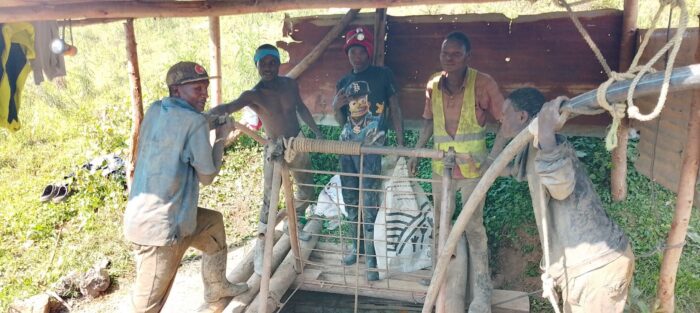
Under a patchwork roof of corrugated iron and weathered timber in Kamwango area of Rongo, Migori County, five men strain against the weight of the earth.
Mud clings to their boots clothes and skin as one grips a thick rope with both hands, leaning backwards as though locked in a tug-of-war with the ground.
Also Read
Meanwhile, another man braces a long pipe against his shoulder, his muscles taut with the effort.
Between them, a crude wooden winch and a rusted metal cage hang above a dark, square shaft that disappears into the earth.
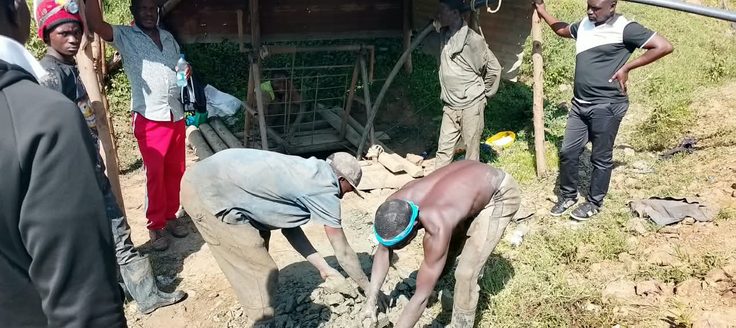
This is not a construction site or a farm but the precarious world of informal gold mining in Rongo, where men descend into hand-dug tunnels in search of a livelihood, hauling buckets of earth and ore from beneath the surface.
But beneath the struggle to extract the precious metal lies another battle, this time over who has the right to explore and exploit the gold deposits, and under what terms.
Landowners in the area are now accusing the Government of fuelling tensions between rival mining companies by allowing a new investor to pursue exploration rights in fields where another company has operated for more than two decades.
The residents have rejected the entry of Havana Natural Resources Limited into the Kamwango mining fields, arguing that the move threatens existing contractual arrangements with B&M Mining Company Limited.
They question how Havana secured exploration rights over an area where B&M says it has invested in exploration and mining activities for more than 20 years.
At the heart of the dispute is the removal of B&M’s name from the National Mining Cadastre, a development that paved the way for Havana to pursue mineral rights in the area.
For the landowners, the issue goes beyond competing claims by mining companies. They fear that their existing agreements, interests and expectations could be undermined by a licensing process they say was never adequately explained to them.
Philis Nyapara, one of the affected landowners, said the community had not been informed about the circumstances surrounding the introduction of the new investor.
“We have a contract with B&M on our land. We have not been made to understand the circumstances surrounding the introduction of the new explorer,” Ms Nyapara said.
Another resident, Derick Otieno, questioned why the Government would allow another company into an area where landowners already had contractual arrangements with an established investor.
“The company we have a contract with has invested millions of cash in this region. Why is the Government going against the same law it should protect?” he asked.
The residents argue that Havana’s entry could undermine investments already made in the mining fields and jeopardise agreements they had entered into with B&M.
Their opposition came to a head two weeks ago when a public participation exercise organised by Havana reportedly turned violent after residents resisted the company’s proposed entry into the area.
Isaiah Odero, another resident, said the community would not accept arrangements that compromised its interests.
“There is no way we can be manipulated by the Government to accept its own interests when we know our welfare is at stake,” he said.
Questions over licence removal
The dispute has also brought into focus the circumstances under which B&M lost its place in the National Mining Cadastre.
The company’s chief executive, Joseph Jones, alleges that its removal from the register was irregular and intended to create room for Havana to secure exploration rights.
Jones questioned how a company that had invested in exploration activities in the region for more than two decades could disappear from the official mining register without formal notification.
“The removal of our licence was never gazetted as is the standard procedure. After two decades of investment in exploration, our licence was removed from the cadastre without formal notification or degazettement. This is an anomaly,” he said.
He maintained that B&M had not been accorded the procedural safeguards required under mining regulations before its interests were removed from the register.
However, Havana has defended its entry into the area, maintaining that its application and subsequent licensing followed the law.
A company official, who requested anonymity, said a review of the mining cadastre showed that no company held an active licence over the area when Havana submitted its application.
“We checked and found that the cadastre had no one licensed by the time we were making an application, and we were licensed. The licence of the previously existing company (B&M) had been cancelled due to non-renewal,” the official said.
The official added that Havana’s entry into the area was facilitated by North Kamagambo Artisanal Mining Cooperative Society, insisting that the company’s intention was not to take over fields already explored by B&M.
Migori and Homa Bay Regional Mining Officer Simon Mganga also confirmed that B&M’s licence had expired by the time Havana was awarded its exploration licence.
“It is true that by the time Havana was being awarded the exploration licence, the licence of the other company had expired,” Mganga said.
He dismissed concerns about B&M’s removal from the cadastre, maintaining that the process had been undertaken in accordance with the law.
Jones, however, disputed this account, questioning the handling of the licensing process and alleging that influential Government officers could have played a role in the removal of B&M’s licence and the subsequent inclusion of its rival.
He further argued that concerns raised by B&M about Havana’s exploration activities had not been properly addressed.
“When we wrote that Havana had done no exploration, its application was effectively changed to prospecting, the preceding step they ignored,” Jones said.
Mganga rejected the allegations, maintaining that his office had acted within its mandate.
He said the mining office would take the lead in resolving the dispute, adding that the two companies would need to agree on how to conduct their activities in the area.
“Definitely, the two will have to sit down and agree on how to co-exist in the mining activities in the area,” he said.
A share of gold wealth
Beyond the competing claims over mining rights, residents say their greatest concern is ensuring that the exploitation of gold in their area translates into tangible benefits for the local population.
They want mining companies operating in the area to support access to health insurance, contribute towards the education of local children and invest in initiatives that improve livelihoods.
The residents argue that the mineral wealth beneath their land should not benefit investors alone but should also contribute to the economic and social development of the host community.
For men who descend into dangerous underground shafts in pursuit of gold, and landowners whose properties sit above the mineral deposits, the stakes extend beyond the ownership of exploration rights.
The unresolved dispute raises questions about the management of mining licences, the protection of existing contractual interests and the extent to which communities hosting mineral extraction benefit from the resources beneath their land.
As Havana and B&M maintain competing positions over the Kamwango fields, the Government faces the challenge of resolving the dispute and restoring confidence among residents whose land has become the centre of a struggle over gold.
Artisanal and small-scale gold mining is a major source of employment and livelihoods in Migori County, with thousands of residents directly and indirectly dependent on the sector.
A report published by the Friedrich Naumann Foundation for Freedom in 2025 estimated that the county had between 158,000 and 258,000 artisanal and small-scale gold miners, although it acknowledged gaps in reliable industry data.
In April 2024, the Department of Mining reported that Migori had 25 registered miners’ cooperatives awaiting operating permits, with Osiri-Matanda in Nyatike Sub-County alone hosting more than 2,000 artisanal miners.
Mining activities also extend to Rongo, Awendo, Kuria, Suna and Uriri.