By GPC Correspondent
China has reaffirmed its commitment to East African regional integration with an annual contribution of USD 180,000 to the East African Community (EAC) budget.
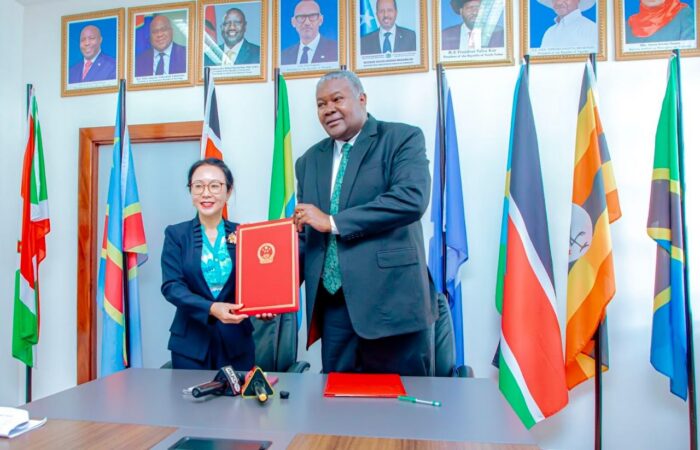
The commitment was renewed on Monday when EAC Secretary General Amb. Stephen Mbundi and the Chinese Ambassador to Tanzania and the EAC, Chen Mingjian, signed a Certificate of Donation at the EAC headquarters in Arusha, Tanzania.
Also Read
Mbundi commended China for what he described as longstanding friendship and practical support to the regional bloc, saying the contribution would continue to support the EAC integration agenda.
“Today’s signing demonstrates China’s continued commitment to the EAC integration agenda and reflects the strong partnership that has developed between our two sides over many years,” Mbundi said.
He pledged that the resources would be used transparently and accountably for the benefit of East Africans.
The annual contribution has supported a range of EAC priorities, including governance and institutional development, regional trade promotion, election observation, senior leadership engagements and communication of the regional integration agenda.
Mingjian said China attached importance to its cooperation with the EAC, noting that the annual support was intended to strengthen regional integration and institutional development.
“China highly values its longstanding cooperation with the East African Community,” she said, adding that Beijing remained ready to work with the EAC on its development priorities and vision for a more integrated region.
Beyond financial support, China has provided capacity-building opportunities, professional training and knowledge exchange programmes for EAC officials. It has also offered logistical assistance, including the donation of eight vehicles in 2023 valued at approximately USD 400,000.
The vehicles have helped strengthen the EAC Secretariat’s ability to coordinate regional meetings and other Community activities.
The two sides are now looking to expand their partnership beyond institutional support into areas such as regional infrastructure and connectivity, trade and market access, climate-change adaptation, green energy, digitalisation, technology transfer, innovation and human-capital development.
The EAC also welcomed plans for a structured EAC-China dialogue to develop a focused pipeline of regional projects aligned with the bloc’s 7th Development Strategy and China’s Global Development Initiative.
Enhanced cooperation
Proposed areas of cooperation include trade-enhancing infrastructure, industrialisation and value addition, digital trade and connectivity, climate adaptation, green energy, food security, development financing and institutional capacity development.
Mbundi said future cooperation should focus on projects that combine financing, technology and knowledge transfer, capacity development and private-sector participation while delivering tangible benefits across East Africa.
“Our objective is to build a forward-looking partnership that contributes to a more integrated, competitive and prosperous East African region,” he said.
Mingjian said there were significant opportunities for deeper cooperation in infrastructure, trade, green development, the digital economy, technology and capacity building.
“We look forward to working with the EAC to build on our achievements and deliver even greater development outcomes for East Africa,” she said.
The latest agreement builds on discussions between the EAC Secretariat and China in June 2026, when the two sides agreed to explore cooperation beyond institutional support towards strategic initiatives targeting sustainable development, economic transformation and regional integration.
The EAC-China relationship now covers institutional financing, capacity development, logistical assistance, infrastructure, trade, knowledge exchange and strategic engagement, with both sides signalling their intention to deepen cooperation in the years ahead.