
By Nyang’au Araka
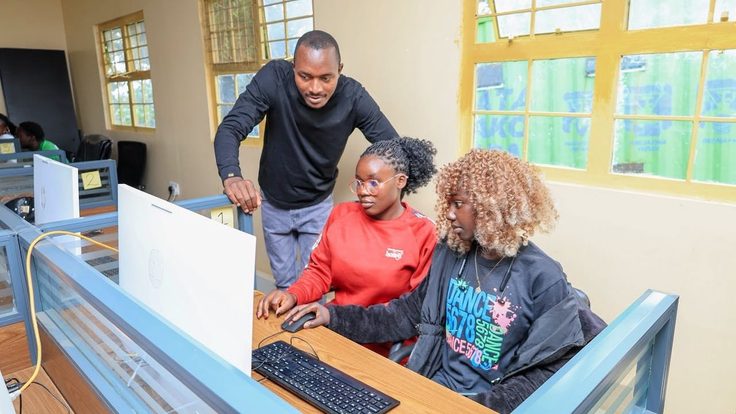
In a brightly lit computer lab, two girls lean in close over a keyboard, their braids falling gently as they focus intently on the screen in front of them.
They are learning the art of digital photo editing; how to retouch, refine colour and bring a portrait to life using professional editing software.
Also Read
On the monitor, a smiling young woman in a soft pink satin bonnet glows against a clean background, offering an example of the beauty and precision they are being taught to create.
One girl guides the mouse while the other points at the keyboard, learning together, experimenting together and discovering that with a computer and creativity, they too can shape stories, build brands and turn their talent into a future career in the digital world.
For these young learners in Nyamira County, the computer laboratory represents more than a classroom.
It is a window into an expanding digital economy where opportunities are no longer confined by geographical boundaries, and where skills acquired in a local training centre can potentially connect young people to clients and employers thousands of kilometres away.
The initiative is part of the Nyamira County Government’s Digital Skills Empowerment Programme, which Governor Amos Nyaribo says has so far reached more than 180 young men and women through training at the county’s ICT Hub.
In an update shared on his Facebook page on Friday, Nyaribo said the programme was preparing young people to explore employment opportunities available online.
“Our free Digital Skills Empowerment Programme at the Nyamira ICT Hub has reached over 180 young men and women, who are ready to navigate the vast online job opportunities,” he said.
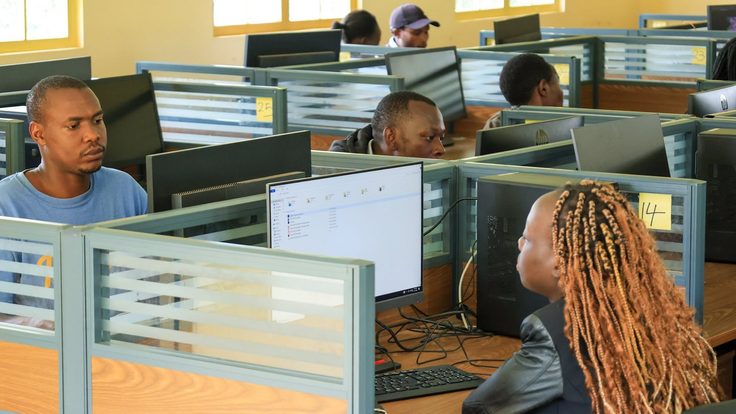
He disclosed that the latest cohort comprises 32 trainees undertaking instruction in seven areas: graphic design, prompt engineering, cybersecurity, virtual assistance, digital marketing, artificial intelligence and web development.
For a young person with an interest in graphic design, for instance, the skills can provide an entry point into photography editing, advertising, social media content creation and branding.
Others can explore opportunities in website development, online marketing, remote administration and emerging AI-related services.
The programme’s growth follows the establishment of the Nyamira County ICT Hub at the county headquarters in October 2025.
When it was launched, the facility was presented as a practical intervention to address youth unemployment by providing access to computers, reliable internet and training in skills that could be monetised in the digital marketplace.
According to our earlier story, the hub was initially equipped with 32 workstations and designed to accommodate monthly cohorts of approximately 30 trainees.
The county had also outlined plans to establish similar facilities across its four sub-counties, with the intention of taking digital training closer to young people.
The first group of 20 trainees graduated after completing a month-long course covering web development, graphic design, cybersecurity, content writing, script writing and virtual assistance.
The launch marked the beginning of an initiative that has since expanded its reach and diversified its training areas.
Nyaribo says his administration intends to register programme graduates by June 2027 in an academy where their progress could be monitored and their professional development nurtured.
Earlier, he also announced plans to help graduates acquire laptops through bank loans to enable them to start working independently.
At the time, 57 graduates received KSh5,000 each in airtime to support their initial efforts to venture into online work, according to a story published by the Kenya News Agency.
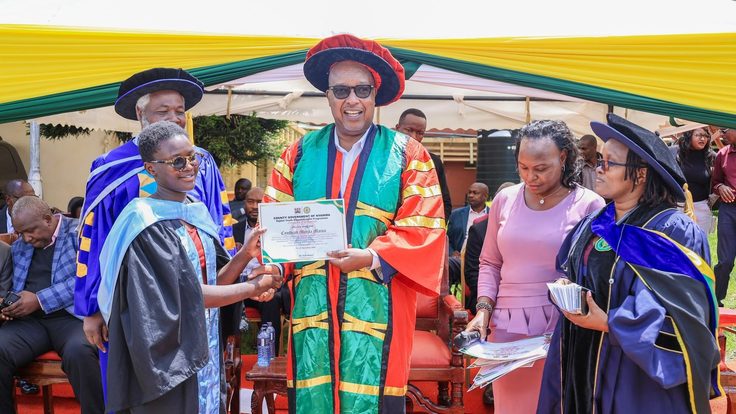
The programme received further attention on November 4, when the governor presided over the graduation of 71 trainees.
During that ceremony, Nyaribo said: “We will establish two additional ICT hubs before June 2027 to respond to growing demand.”
He also outlined an ambitious plan to facilitate at least 500 young people to undertake one-year advanced practical training, signalling an intention to move beyond introductory digital literacy towards more specialised skills development.
The latest Facebook update appears to have resonated with residents, judging by the responses it attracted.
Several commenters welcomed the initiative, while others saw it as an opportunity to improve their employment prospects.
“Technology is power,” wrote Joab Achacha, while Clinton Rira expressed optimism about the programme’s impact, saying: “Nyamira youths are now smiling.”
Another resident, Semenyo Semenyo, praised the governor, writing: “Kazi safi gavana. Mambo ni tutam.”
Other responses were particularly revealing because they went beyond congratulating the county administration, pointing to a strong appetite for information about how to access the training.
“Where and when the next cohort is enrolled?” asked one Facebook user, while another wanted to know: “How is selection done?”
“Can I join at the moment,” asked Grace Gracious, reflecting the interest among residents who may have missed earlier intakes.
The interest comes at a time when Kenya is investing heavily in digital employment as part of its wider economic transformation agenda.

The 2026 Budget Policy Statement indicates that more than 300,000 young Kenyans are earning income online through initiatives including Ajira Digital, Jitume and the expanding business process outsourcing sector.
The national government has also been pursuing the expansion of digital infrastructure.
Recently, the Government commissioned the West Mugirango ICT Hub in Nyamira, with the State Department for ICT announcing plans to establish 1,450 digital hubs countrywide and train two million young people.
The development gives the county’s digital skills initiative an additional dimension, with opportunities to build on the infrastructure being rolled out nationally.
A study evaluated by the Abdul Latif Jameel Poverty Action Lab (J-PAL), involving 1,115 low-income young people in Kenya, found that combining digital skills training with job referrals increased participants’ monthly earnings by 37 per cent and reduced unemployment by 10 percentage points.
However, researchers found that training without a corresponding job referral did not produce similar improvements in employment or earnings.
Nyaribo’s promise to help graduates access computers, establish an academy to track their progress and expand training facilities could provide an important foundation.