By Nyang’au Araka
babahezel@gmail.com
An ecological threat is unfolding in Kenya, as a parasitic weed continues to spread its tendrils across the nation.
Also Read
Identified as dodder, the rootless and leafless weed that falls under the genus Cuscuta has also been reported in other parts of the world, including Japan and the United States of America (USA).
In Kenya, dodder has not spared key government institutions including the University of Nairobi (UoN) where it has invaded flowerbeds, hedges and ornamental trees.
The flowerbeds outside UoN Towers and the engineering department are among those affected, just like those around the Kenya Broadcasting Corporation, Hotel Norfolk, among others.
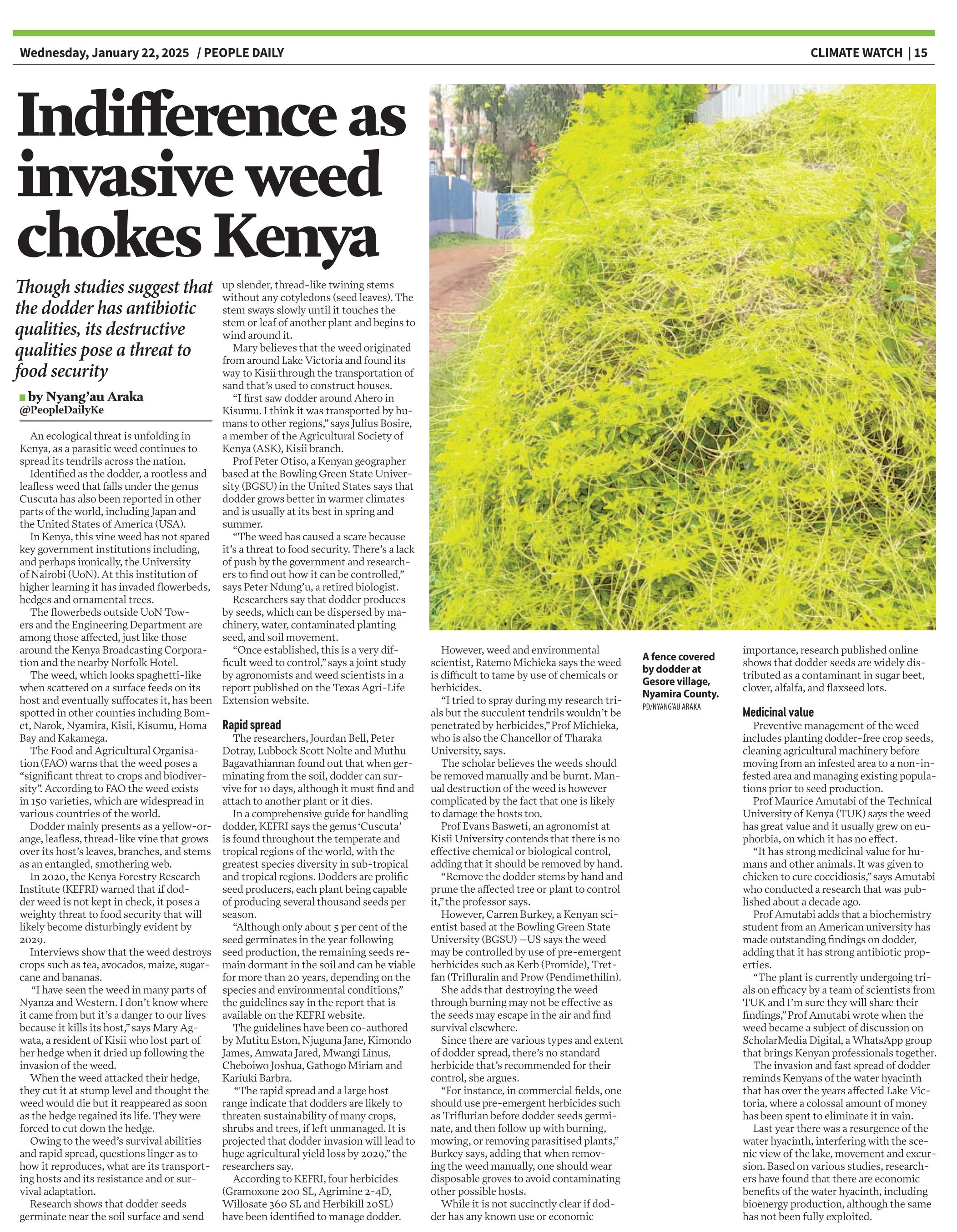
The weed, which looks like spaghetti scattered on a surface feeds on its host and eventually suffocates it, has been spotted in other counties including Bomet, Narok, Nyamira, Kisii, Kisumu, Homa Bay and Kakamega.
The Food and Agricultural Organization (FAO) says the weed exists in 150 varieties, which are widespread in various countries of the world, and warns that it poses a “significant threat to crops and biodiversity”.
In the year 2020, the Kenya Forestry Research Institute (KEFRI) warned that if dodder weed is not kept in check, it poses a weighty threat to food security that will likely become disturbingly evident by 2029.

Smothering web
Dodder mainly presents as a yellow-orange, leafless, thread-like vine that grows over its host’s leaves, branches, and stems as an entangled, smothering web.
Interviews show that the weed also destroys crops such as tea, avocados, maize, sugarcane and bananas.
“I have seen the weed in many parts of Nyanza and Western. I don’t know where it came from but it’s a danger to our lives because it kills its host,” says Mary Agwata, a resident of Kisii.
“Part of our hedge dried up following the invasion of the weed, and we were forced to cut it down.”
Owing to the weed’s survival abilities and rapid spread, questions linger as to how it reproduces, what are its transporting hosts and its resistance and/or survival adaptation.
Research shows that dodder seeds germinate near the soil surface and send up slender, thread-like twining stems without any cotyledons (seed leaves), which sway slowly until it touches the stem or leaf of another plant and begins to wind around it.
Ms Agwata believes that dodder originated from around Lake Victoria, and found its way to Kisii through the transportation of sand that’s used to construct houses.
“I first saw dodder around Ahero in Kisumu County. I think it was transported by humans to other regions,” says Julius Bosire, a member of the Agricultural Society of Kenya (ASK), Kisii branch.

Warmer climates
Prof. Kefa Otiso, a Kenyan geographer based at the Bowling Green State University (BGSU) in the US says that dodder grows better in warmer climates and is usually at its west in spring and summer.
Peter Ndung’u, a retired biologist says that dodder affects food, cash crops as well as ornamental plant trees, and reproduces by fragments which make it a menace.
“The weed has caused a scare because it’s a threat to food security. There’s a lack of push by the government and researchers to find out how it can be controlled,” Mr Ndung’u says.
Ms Agwata says when the weed attacked their hedge; they cut it at stump level and thought the weed would die but it reappeared as soon as the hedge regained its life.
Researchers say that dodder produces by seeds, which can be dispersed by machinery, water, contaminated planting seed, and soil movement.
“Once established, this is a very difficult weed to control,” says a joint study by agronomists and weed scientists in a report published on the Texas Agri-Life Extension website.
The researchers, Jourdan Bell, Peter Dotray, Lubbock Scott Nolte and Muthu Bagavathiannan found out that, “When germinating from the soil, dodder can survive for 10 days, but it must find and attach to another plant or it will die.”

The guidelines
In a comprehensive guide for handling dodder, KEFRI says the genus “Cuscuta” is found throughout the temperate and tropical regions of the world, with the greatest species diversity in sub-tropical and tropical regions.
The guidelines have been co-authored by Mutitu Eston, Njuguna Jane, Kimondo James, Amwata Jared, Mwangi Linus, Cheboiwo Joshua, Gathogo Miriam and Kariuki Barbra who say that dodders are prolific seed producers, each plant being capable of producing several thousand seeds per season.
“Although only about 5% of the seed germinates in the year following seed production, the remaining seeds remain dormant in the soil and can be viable for more than 20 years, depending on the species and environmental conditions,” the authors say in the report that is available on the KEFRI website.
“The rapid spread and a large host range indicate that dodders are likely to threaten sustainability of many crops, shrubs and trees, if left unmanaged. It is projected that dodder invasion will lead to huge agricultural yield loss by 2029,” the KEFRI researchers say.
According to KEFRI, four herbicides (Gramoxone 200 SL, Agrimine 2-4D, Willosate 360 SL and Herbikill 20SL) have been identified to manage dodder.
However, weed and environmental scientist, Ratemo Michieka says the weed is difficult to tame by use of chemicals or herbicides.
“I tried to spray during my research trials but the succulent tendrils wouldn’t be penetrated by herbicides,” Prof. Michieka who is the Chancellor of Tharaka University said.
He added that the weeds should be removed manually and be burnt.
Manual destruction of the weed is however complicated by the fact that one is likely to damage the hosts too, and it is painful to do so due to their economic and aesthetic value.

Destroy them manually
Prof. Evans Basweti, an agronomist at Kisii University contends that there is no effective chemical and/or biological control for dodder, adding that it should be removed by hand.
“Remove the dodder stems by hand and prune the affected tree or plant to control it,” Prof. Basweti says.
This view is shared by Mr Ndung’u who adds that destroying both the weed and the host is the way to go.
“While small infestations can be removed by hand to prevent the production of seed, the recommendation for controlling extensive infestations is to remove the host plant and, if possible, replant with non-host crops,” says a research published by New Mexico University.
However, Carren Burkey, a Kenyan scientist based at the Bowling Green State University (BGSU) –US says the weed may be controlled by use of pre-emergent herbicides such as Kerb (Promide), Tretfan (Trifluralin and Prow (Pendimethilin).
She adds that destroying the weed through burning may not be effective as the seeds may escape in the air and find survival elsewhere.
Since there are various types and extent of dodder spread, there’s no standard herbicide that’s recommended for their control, she says.
“For instance in commercial fields, one should use pre-emergent herbicides such as Triflurian before dodder seeds germinate, and then follow up with burning, mowing, or removing parasitized plants,” Ms Burkey says.
“When destroying the weed manually, one should wear disposable groves to avoid contaminating other possible hosts that are yet to be infected,” Ms Burkey says.
While it is not succinctly clear if dodder has any known use or economic importance, research published online shows that dodder seeds are widely distributed as a contaminant in sugar beet, clover, alfalfa, and flaxseed lots.

Curb spread
Preventive management of the weed includes planting dodder-free crop seeds, cleaning agricultural machinery before moving from an infested area to a non-infested area, and managing existing populations prior to seed production so as not to spread dodder seeds.
Prof. Maurice Amutabi of the Technical University of Kenya (TUK) says the weed has great value and it usually grew on euphorbia, on which it has no effect.
“It has strong medicinal value for humans and other animals. It was given to chicken to cure coccidiosis,” says Prof. Amutabi who conducted a research that was published about a decade ago on wwww.taylorfrancis.com.
Prof Amutabi adds that a biochemistry student from an American university has made outstanding findings on dodder, adding that it has strong antibiotic properties.
“The plant is currently undergoing trials on efficacy by a team of scientists from TUK and I’m sure they will share their findings,” Prof Amutabi wrote when the weed became a subject of discussion on ScholarMedia Digital, a WhatsApp group that brings Kenyan professionals together.
The invasion and fast spread of dodder reminds Kenyans of the water hyacinth that has over the years affected Lake Victoria, where a colossal amount of money has been spent to eliminate it in vain.
In February last year, Nation reported the resurgence of the water hyacinth, “which interferes with the scenic view of the lake, movement and excursion”.
The aggressive weed appears when certain conditions such as high nutrient loads that favour its growth present in the lake.
Based on various studies, researchers have found that there are economic benefits of the water hyacinth, including medicine and bioenergy production although the same has not been fully exploited.
- This story was also published by People Daily: https://media.cdn.pagesuite.com/clipping/html5/05a86bd4-cb8c-4616-927e-565c6aa862d4/15/20250122065347410/clipping.jpg