By Nyang’au Araka
The National Assembly is sometimes home to light moments, thanks to Suba North legislator, Millie Odhiambo who comes out as a stickler of house procedures.
The self-branded “bad girl” often pushes for women voices in the house and does not shy from telling their male counterparts off.
Also Read
Recently, Odhiambo raised an issue that was more or less a clash between culture and parliamentary procedure.
She had spotted Bomet Women Representative Linet Chepkorir alias Toto kneeling as she spoke to Kosgei- a male colleague.
Odhiambo caught Speaker Moses Wetangula’s eye and said, “Honourable Toto is kneeling….I know the member she’s speaking to is older and honourable but is it in order for her to be kneeling?”
This appeared to have caught Toto unaware and she returned to her seat where she only laughed and watched as more of her colleagues jumped into the talk.
“In this house, we are presumed to be equal,” Odhiambo said.
Perhaps oblivious of the dimension the concern was taking, Wetangula reminded her that, “the last time the word kneeling was used in this house, a Vice President (Joseph Karanja) lost his job.”
Dr Karanja, who was sacked in 1988, was President Daniel Moi’s principal assistant at the time.
Wetangula wondered, lightly so, if Odhiambo wanted Kosgei to lose his job.
“Toto has just come from Uganda where she learnt to kneel before men…and that’s how it should be,” Suna East’s Junet Mohamed said, adding that his remarks were on a light note.
This caused lengthy uproar particularly from female Parliamentarians.

Unconvinced, Kisii County MP, Donya Aburi claimed that the statement might be taken serious by men in the country and end up ruining marriages.
“It’s actually men who should kneel before women…” Donya said.
During the heated argument that lasted about four minutes, Wetangula rose from his seat to calm the house.
“….Jack Wamboka will tell you that in Bumula where we come from, a woman kneeling before her husband is an ordinary thing,” he said as his voice got subdued by the shouting in the house.
Amid laughter, Mohamed said that they were just giving tips on how to spice marriages, and make them better and enjoyable.
“Even men kneel before their wives in some situations,” he said.

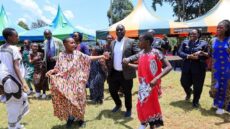
It should be appreciated that women kneeling before men is a cultural practice in various African communities, particularly in some parts of West, Central, and East Africa.
In those communities, it symbolizes respect, humility, and acknowledgment of authority, age, and status.
In the Yoruba culture of Nigeria, a woman may kneel when greeting a man, especially an elder, while amongst the Akan of Ghana, kneeling or bowing is a sign of respect to her elders, especially during formal ceremonies.
In recent times, the cultural practice of kneeling has lost relevance, especially in relation to gender equality and women’s rights.
Some people view kneeling of women before men as a symbol of patriarchy, subordination, or inequality.