By Ongaga Ongaga
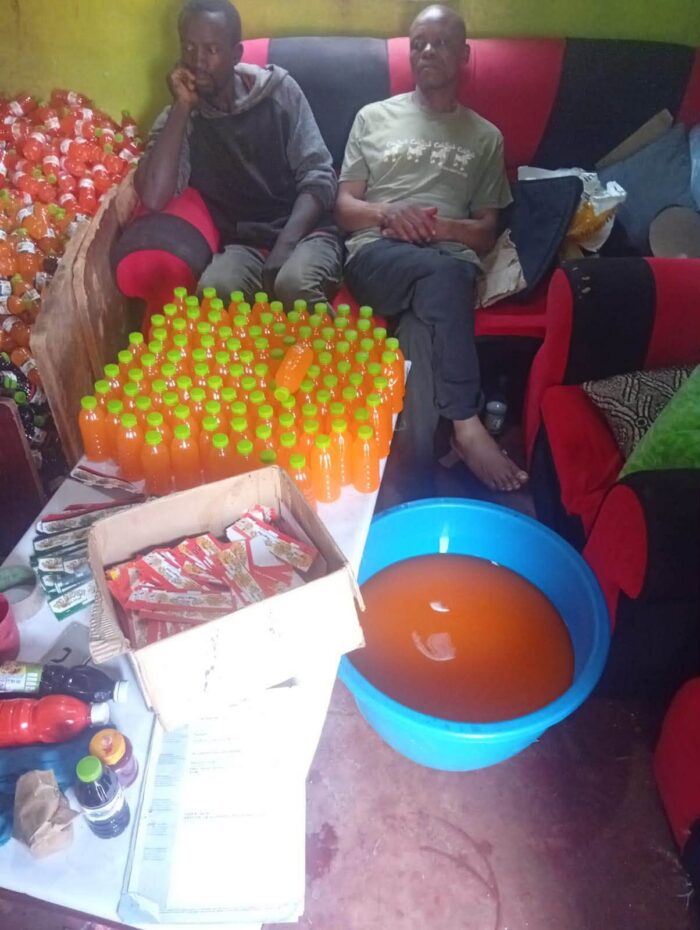
What appeared to be an ordinary homestead in Muthua, Kabete, was allegedly hiding a secret operation where counterfeit juice was being prepared for the market.
The operation came to light after a vigilant member of the public raised the alarm, prompting detectives from Kabete Police Station to raid the premises and arrest two men.
Also Read
According to the Directorate of Criminal Investigations (DCI), Alex Mwaruta and James Munala Inyangala were found at the homestead allegedly engaged in the production of counterfeit juice.
A search of the premises uncovered what detectives described as a counterfeiting setup, including about 1,400 filled 200ml and 300ml bottles of suspected counterfeit juice.
The detectives also recovered 56 cartons of empty bottles, five packets of bottle tops, two blue drums and three assorted-colour basins, pointing to an operation that had the equipment and materials to package the alleged products.
Among the other items recovered were office glue, rubber stamps, ink and assorted stickers.
Detectives also found an expired certificate authorising the use of the Standardisation Mark for a well-known juice brand, raising further questions about how the suspected operation was being conducted.
The search also yielded assorted powdery and colourless substances packed in polythene bags in 50-gram portions and in 200ml and 300ml bottles.
The discovery offered a glimpse into what investigators believe was taking place away from the scrutiny normally associated with commercial beverage production.
The two suspects were arrested at the premises, while Crime Scene Investigation officers were called in to document and process the scene.
The recovered items were secured as exhibits as investigations into the alleged counterfeiting operation continue.
The case has also raised concerns about what unsuspecting consumers may encounter when buying beverages whose source and production conditions they cannot establish.
Unlike licensed beverage manufacturers operating under regulatory requirements, illicit production facilities may operate outside established standards on hygiene, ingredients, storage and packaging.
The DCI warned that counterfeit beverages produced in unregulated and unhygienic environments can expose consumers to serious health risks.
Such operations can also affect legitimate manufacturers whose products may be imitated and sold under their brands, while denying the government revenue through illegal trade.
For now, detectives are pursuing the circumstances surrounding the alleged production and intended distribution of the suspected counterfeit juice, as the two suspects remain in custody.