By Nyang’au Araka
Nearly 200 years after two men were captured in one of the earliest photographs of human beings, filmmakers have identified the exact spot where they stood in Paris, France.
The location, along the historic Boulevard du Temple, has been marked with a bronze plaque unveiled by the city of Paris on October 15, 2026, commemorating a landmark moment in the history of photography.
Also Read
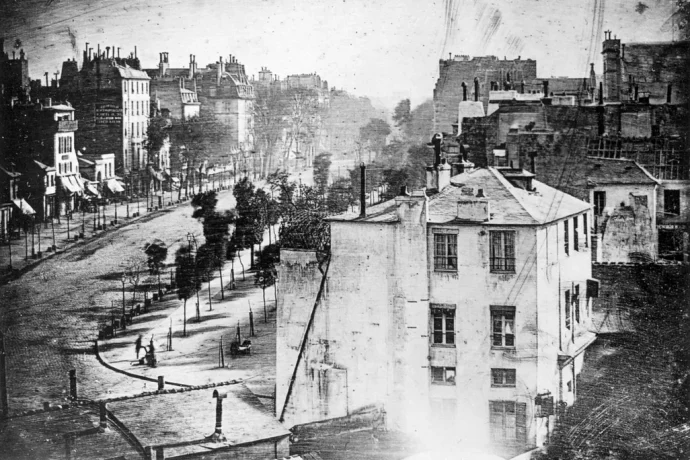
According to the Smithsonian Magazine published this week, the photograph was taken in 1838 by French artist and inventor Louis Daguerre, whose pioneering photographic process became known as the daguerreotype.
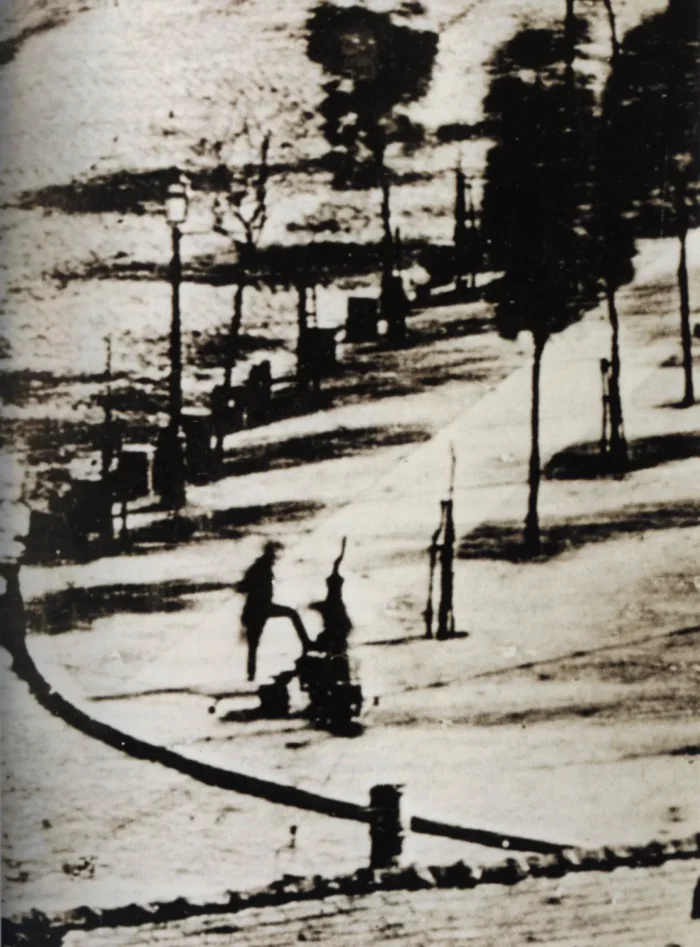
It shows a man having his shoes shined on a busy street, with the two figures believed to be the first people captured in a photograph.
“Although the boulevard was bustling with activity, the long exposure required by Daguerre’s camera meant that moving pedestrians did not appear in the image,” reports the Smithsonian.
“The shoeshiner and his customer remained still long enough to be recorded.”
The exact location of the shoeshine stand was subsequently lost as Paris underwent extensive urban redevelopment, including major changes to the boulevard and the creation of Place de la République.
Two-year search reconstructs historic Paris
The mystery attracted the attention of three filmmakers — Maximilien Van Aertryck, Axel Danielson and Kalle Boman — who began investigating in 2024.
Their search involved examining historical archives, reconstructing the Paris streetscape of 1838 and commissioning three-dimensional models to establish where the photograph had been taken.
The team discovered that three buildings from Daguerre’s era were still standing, providing important clues to the original location.
They also enlisted two architectural firms to independently calculate the position of the shoeshine stand. The firms identified points only a few feet apart, allowing the filmmakers to settle on an approximate midpoint.
Van Aertryck said the idea began as a casual conversation among colleagues while they were at Place de la République.
“We’re pretty much where that photo was taken. It would be funny to try and find where exactly the shoeshiner and his client were standing,” he recalled telling his colleagues, according to reports by Radio France and The New Yorker.
Daguerre’s studio and a neighbouring diorama theatre were destroyed by fire in 1839, while subsequent demolitions and redevelopment erased much of the surrounding landscape.
The bronze plaque, titled Un Détail Imprévu — French for “An Unexpected Detail” — now marks the identified site.
Photograph captures the dawn of a new era
For the filmmakers, the image represents more than a technical breakthrough. It offers an early record of an ordinary social interaction and a moment of work, preserved at a time when photography was still in its infancy.
“This is the first photo of a social interaction and of labour,” Van Aertryck told French newspaper Le Monde, describing the image as magical and poetic.
Daguerre’s achievement built on the work of his late collaborator Nicéphore Niépce, who produced the earliest surviving photograph, an image that required several days of exposure.
The discovery also highlights how technological advances can transform society, leaving future generations to interpret their consequences.
Van Aertryck said the photograph and the plaque remind people that earlier generations, too, experienced technological upheavals whose implications they had to understand and manage.
Visitors walking through Place de la République can now pause at the historic spot, nearly two centuries after the seemingly ordinary act of shining a man’s shoes helped create an enduring milestone in photography.