By GPC News Desk
The East African Community (EAC) and Germany have stepped up cooperation on pandemic preparedness, climate financing and regional integration following high-level talks in Berlin.
EAC Secretary-General Ambassador Stephen P. Mbundi held discussions with Germany’s Federal Minister for Economic Cooperation and Development, Reem Alabali-Radovan, and the Head of the Africa Department at the Federal Ministry for Economic Cooperation and Development (BMZ), Philipp Knill, on October 14, 2026.
Also Read
The talks focused on strengthening regional health security, mobilising climate finance, promoting investment and advancing regional integration among EAC Partner States.
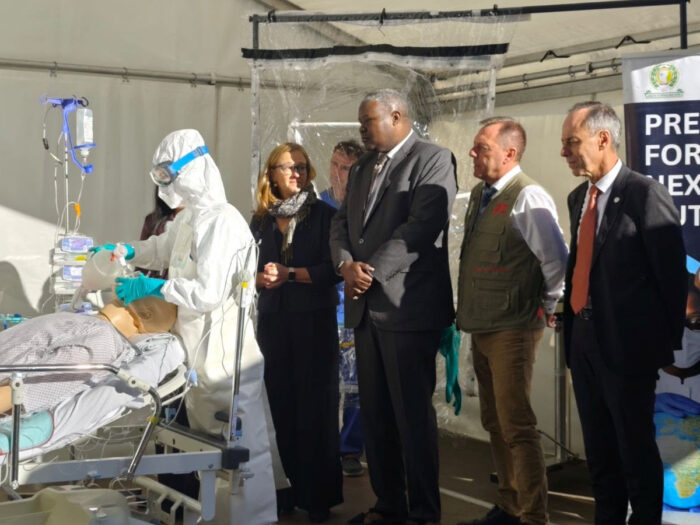
During a simulation exercise on the clinical management of Ebola patients organised with support from Charité – Universitätsmedizin Berlin and the Deutsche Gesellschaft für Internationale Zusammenarbeit (GIZ), Mbundi commended Germany for its longstanding support for regional health security.
He highlighted achievements under German-supported programmes, including the training of 500 laboratory experts and the procurement and deployment of 10 mobile laboratories across EAC Partner States to strengthen disease surveillance.
The programmes have also trained 80 frontline experts in the management of Ebola and other highly infectious diseases.
A further 30 clinical workers are undergoing training in Kinshasa, while another 50 are expected to begin training as frontline experts in eastern Democratic Republic of Congo in November 2026.
Mbundi said sustained investment in regional preparedness was essential, noting that disease outbreaks such as Ebola posed significant social and economic risks and required coordinated cross-border responses.
“The EAC has mobilised available resources to support the response to the Ebola outbreak in eastern DRC and strengthen preparedness in all EAC Partner States,” he said.
Alabali-Radovan underscored the importance of rapid response, international solidarity and sustained investment in global health security to prevent and contain infectious disease outbreaks.
Regional integration and climate financing
In a separate meeting with Knill, Mbundi expressed appreciation for Germany’s contribution to the EAC’s regional integration agenda, particularly in institutional strengthening, health, education, trade infrastructure and climate resilience.
Germany has supported several regional initiatives, including the development of the EAC’s Seventh Development Strategy, strengthening the regional network of public health reference laboratories and establishing the EAC Regional Centre of Excellence for Vaccines, Immunisation and Health Supply Chain Management in Kigali, Rwanda.
The discussions also addressed climate financing, with Germany committing between €3 million and €5 million towards the development and co-financing of a regional climate project.
The EAC said it had made progress in developing a pipeline of climate finance projects and called for stronger partnerships to mobilise additional public and private investment.
Mbundi also emphasised the need to strengthen regional pharmaceutical manufacturing and explore opportunities for pooled procurement of medicines, vaccines and other essential medical products.
The Secretary-General also met Bayer AG Vice-President and Head of the Global Health Unit Hugo Hagen, GIZ Managing Director Anna Sophie Herken, and Equity Group Foundation Associate Director for Health Dr Patricia Owira.
The meetings explored opportunities for cooperation in strengthening health systems across EAC Partner States.