By Nyang’au Araka
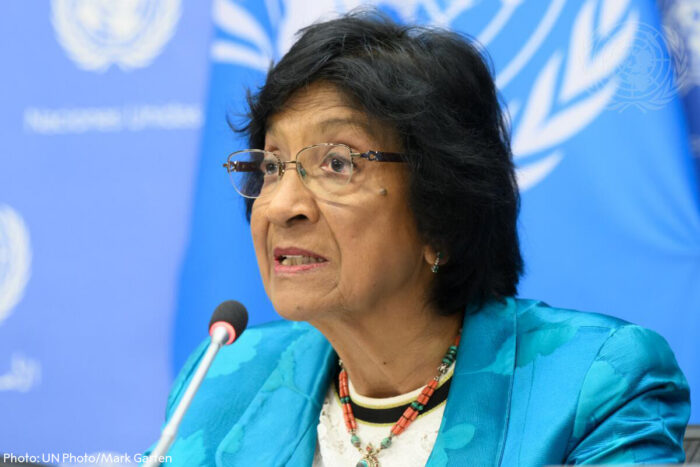
A South African jurist has won the 2026 Nobel Peace Prize for her contribution to international law and the fight against impunity.
The Norwegian Nobel Committee announced the award on Friday, October 9, recognising Navi Pillay, whose work helped establish rape and sexual violence as crimes that can constitute genocide.
Also Read
The award is in recognition of her efforts to promote peace, strengthen international justice and ensure that war crimes, crimes against humanity and genocide are prosecuted.
Pillay, 84, has built an international reputation through decades of legal work challenging discrimination and holding individuals and states accountable for serious human rights violations.
Born into a family of Indian Tamil origin in Durban, South Africa, during apartheid, she rose through the legal profession despite the racial discrimination and exclusion that defined the country’s political system.
She began her career defending Nelson Mandela and other opponents of apartheid before serving in several influential judicial and human rights positions, including as a judge of South Africa’s High Court, the International Criminal Tribunal for Rwanda and the International Criminal Court.
She also served as United Nations High Commissioner for Human Rights and, until recently, chaired the UN Independent International Commission of Inquiry on the Occupied Palestinian Territory.
Pillay currently serves as a judge at the International Court of Justice in the case in which Myanmar is accused of genocide against the Rohingya.
Landmark rulings on rape and genocide
The Nobel Committee particularly highlighted Pillay’s contribution to landmark international legal decisions that expanded the understanding of sexual violence and genocide.
Her influence was significant in the International Criminal Tribunal for Rwanda’s determination that rape and sexual violence could constitute crimes against humanity and acts of genocide.
The same proceedings produced another legal breakthrough by establishing that a person could face charges of incitement to genocide solely on the basis of spreading propaganda.
These developments strengthened the legal framework for prosecuting those who use sexual violence and incitement to facilitate mass atrocities.
The committee praised Pillay’s independence, expertise and determination, describing her as one of the most respected international jurists of her time.
Her career, it said, demonstrated how legal institutions could help prevent violence, protect victims and hold powerful individuals accountable.
Nobel committee warns against impunity
The award comes amid growing concerns about international conflicts and pressure on institutions responsible for enforcing international law.
The Nobel Committee warned that the international legal order was facing serious challenges as powerful states increasingly resorted to political and military influence at the expense of established legal frameworks.
“The key insight was that lasting peace must be built on legal principles, not on the will of the strong or a fragile balance of power,” the committee said in its announcement.
It stressed that international law was no longer merely an additional tool for maintaining peace and security, but an essential requirement for preventing and resolving conflicts.
The committee also warned that when military or political power takes precedence over justice, it undermines stability, trust and peaceful coexistence.
In explaining its decision, the committee said Pillay had consistently emphasised the responsibility of individuals and states to respect the rule of law, regardless of their position or influence.
“Peace requires justice,” the committee declared, underscoring the central message behind this year’s award.
A career spanning apartheid and international justice
Pillay’s journey from apartheid-era South Africa to the world’s leading international judicial institutions has made her a prominent figure in the struggle for equality and accountability.
Her legal career has included confronting structural discrimination at home and participating in proceedings addressing some of the most serious crimes recognised under international law.
Through her work in international tribunals and the United Nations, she has helped shape legal principles intended to protect vulnerable populations and ensure that perpetrators of atrocities face justice.
The Nobel Committee said her commitment to human dignity and international legal principles offered hope to victims of violence and conflict.
The 2026 award also marks 125 years since the first Nobel Peace Prize was presented, reinforcing the committee’s longstanding emphasis on resolving conflicts through legal mechanisms, diplomacy and international cooperation.
The committee called for stronger support for international courts and legal institutions, warning that a world without the rule of law would be unjust, unwise and inhumane.
Pillay’s recognition places renewed attention on the role of international justice in a world grappling with armed conflicts, allegations of genocide and demands for accountability.
The Nobel Peace Prize is awarded in accordance with the will of Alfred Nobel, which calls for recognition of efforts to promote fraternity between nations and advance peace.