By GPC News Desk
Nyamira Governor Amos Nyaribo has issued cheques to 20 coffee farmer co-operatives as part of efforts to strengthen the co-operative movement and revive the county’s coffee subsector.
The cheques were issued at Bisembe Coffee Factory, where Nyaribo said stronger farmer organisations would help producers access affordable credit and transition from subsistence farming to profitable agricultural enterprises.
Also Read
The initiative is being implemented in partnership with the National Agricultural Value Chain Development Project (NAVCDP), a World Bank-supported programme designed to strengthen farmer organisations, improve access to finance and enhance participation in agricultural value chains.
NAVCDP uses SACCOs and Farmer Producer Organisations (FPOs) as part of its strategy for improving farmers’ access to capital and productive agricultural investments.
Nyaribo said strengthening co-operatives was central to his administration’s efforts to put more resources into the hands of farmers.
“Strengthening the Co-operatives movement is one of the ways of advancing affordable and accessible financial support to farmers in transitioning to entrepreneurship,” he said.
The Governor said the support was part of deliberate interventions to revive and revitalise coffee production, which remains an important agricultural activity in the region.
“It is a commitment we are undertaking as a sustainable way of ensuring farmers can access credit to produce more,” Nyaribo said. “Indeed, coffee reforms must culminate in putting more money into the pocket of the farmer.”
Among the beneficiaries, Kemera Farmers Co-operative Society received an Enterprise Development Grant of Sh9 million, while Bisembe Farmers Co-operative Society secured Sh8.1 million.
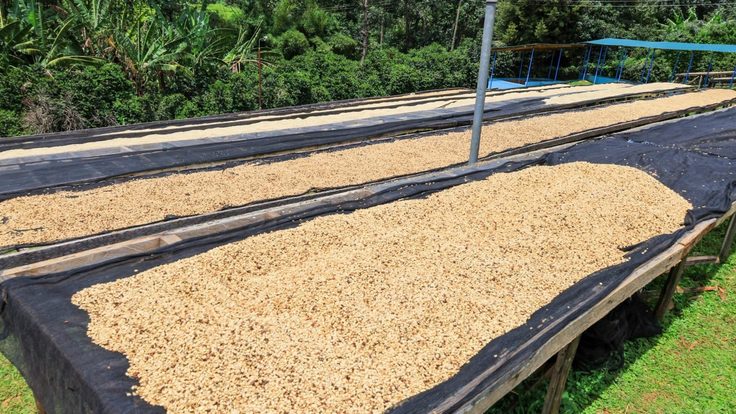
At Bisembe, where the total investment footprint was put at Sh9 million, the support has facilitated improvements to coffee-processing infrastructure, including a greenhouse drying structure, metallic drying beds and security installations.
The interventions are intended to improve handling and processing of coffee and strengthen the capacity of farmer organisations to participate more effectively in the value chain.
Nine coffee Farmer Producer Organisations in Nyamira also received inclusion grants under the wider programme.
The World Bank has previously documented NAVCDP’s use of matching grants and inclusion grants to strengthen farmer organisations and agricultural SACCOs, including support for coffee-processing infrastructure and revolving funds.
Nyaribo urged farmers to make regular savings through their SACCOs, saying stronger savings would improve their financial standing and capacity to obtain loans for productive activities.
He also cautioned SACCO leaders to manage the funds responsibly and ensure that the financing serves the intended farmers and enterprises.

The Governor thanked the national government, NAVCDP, the New Kenya Planters’ Cooperative Union (KPCU) and other partners for supporting efforts to make the coffee value chain more productive and sustainable.
“We thank the National Government through the NAVCDP, the New KPCU and other partners for working with us towards profitable and sustainable livelihoods in this critical value chain,” he said.
The county is also working with the New KPCU on farmer training and the provision of coffee seedlings as part of its wider strategy to increase production and improve the quality and value of coffee produced in Nyamira.
Meanwhile, Nyaribo announced the murraming of 10.5 kilometres of roads in Ekerenyo Ward to ease transportation of agricultural produce.
The roads include the 3.8-kilometre Nyairanga Junction–Nyairanga VTI–Esteni (Iyabe) road, the three-kilometre Kea–Rianyamweno–Nyanderema–Sere road, the 2.5-kilometre Ekegogi–Nyangundo–Riechieri road and the 1.2-kilometre Itibonge–Chichuma–Nyamaruma stretch.
He said county road machinery was being deployed to keep roads passable, linking farmers to markets and agricultural facilities.
The interventions come as Nyamira continues to identify coffee as an important component of its agricultural development agenda.
County planning documents also provide for coffee nurseries, seedling distribution, farmer training and the formation and strengthening of farmer marketing structures.
Nyaribo said the ultimate objective was to create farmers and farmer organisations capable of running viable agricultural enterprises.
“Our goal is to build productive farmers, strong farmer organisations and profitable agricultural enterprises,” he said.